- The Pearl Cluster- Southern Hemisphere
I was fortunate enough to travel to Sydney, Australia the summer before my eighth grade year with my dance team. We went there for an international dance conference and it was the first time many of the girls in my group ever traveled outside of the country. The furthest I traveled outside of the United States at that point was to Canada where my godparents lived for a time. However, this was the first opportunity I received to travel so far away from America; even better, without my parents! Our dance instructor and two other female teachers from our school served as chaperones and we all were boarded with host families, which was a treat in itself.
Australia is a beautiful country and I truly hope I have the chance to travel there again. Very soon. My trip took place about fifteen years ago and at that time in 1994 Sydney was in preparations to host the 2000 Summer Olympics. I got to see the beginning stages of the venues' construction. I was impressed by the overall cleanliness of the country, a stark contrast to the average American city. The people were absolutely fantastic, though the ones I met all asked me if I was a Baywatch fan like they were. I wasn't. While all of them had heard of Chicago, they really did not have too many reference points for the city, excluding the then-Tallest Building in the World status that belonged to the Sears Tower, as most Hollywood movies focus on Los Angeles and New York City.
The most stunning view in the country was not the Sydney Opera House or the Blue Mountains or Darling Harbor, though all of those sites were gorgeous. No, my fondest memories were of the night sky in Sydney. Being born and bred within the city limits of Chicago, I saw very few stars at night. I have always loved looking at the few constellations I could see such as the Big Dipper, Little Dipper, Orion, Cassiopeia, and on occasion the Pleiades among others. Of course, Venus and Mars are also viewable even though the light and general air pollution in the city. I had never traveled far enough outside of the city to truly see an unobstructed view; even visiting friends in the Chicago suburbs did not provide this. Looking at stars in pictures just isn't the same as seeing them in person.
But in Sydney...oh, the stars are breathtaking! Sure, it is the Southern Hemisphere and I would never see those stars again until I travel south of the equator. The sky itself looks like the richest, lushest black velvet and the stars the most flawless of diamonds. Even in Sydney, I saw more stars dance across the firmament than I ever did in Chicago. A dance class my group attended ran into the night and it was this site that greeted me as we left. Looking at the reactions on our faces, a casual observer could tell we probably lived in the city our entire lives. I remember standing there and saying one word, "Whoa."
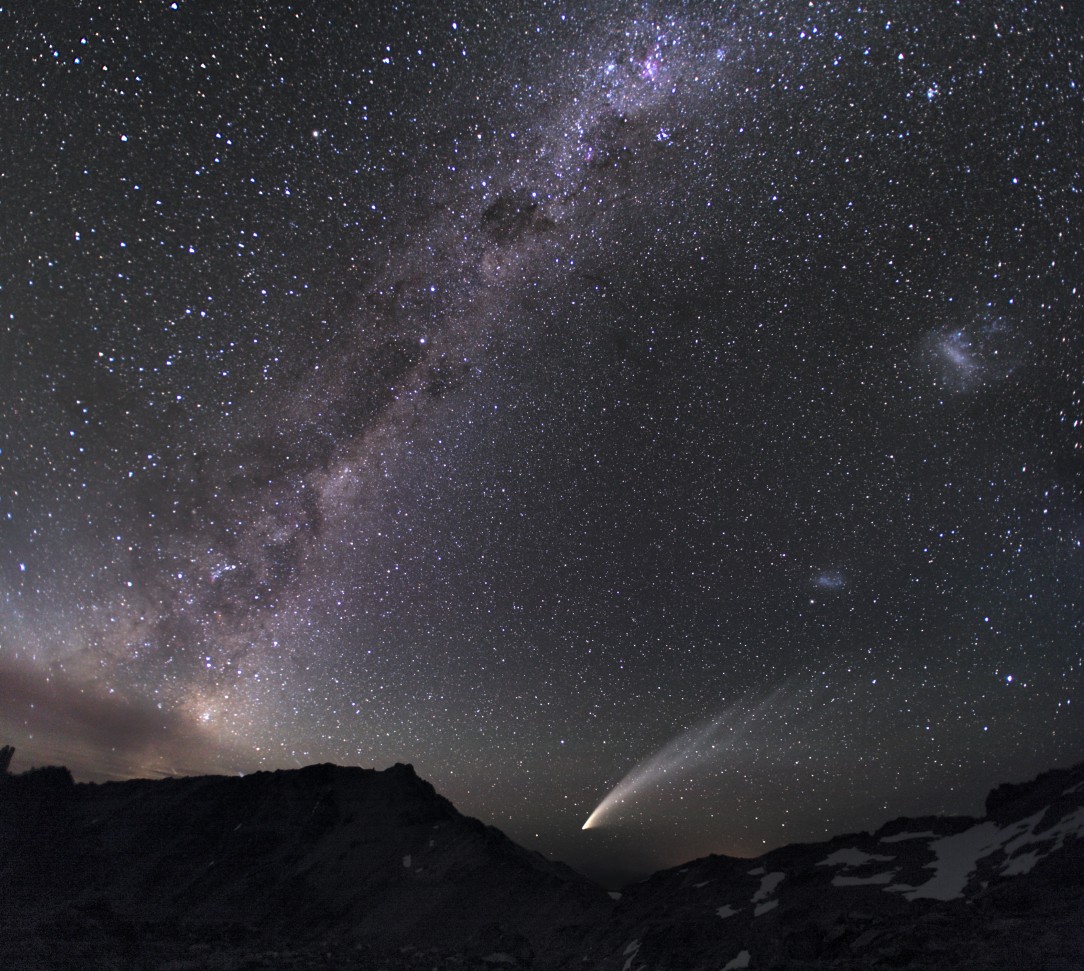
My host family took me into the Blue Mountains the next day, as it was a free day for the conference attendees. As we were preparing to leave the mountains that night, I could see the Milky Way and the Magellanic Clouds, the Crux and so many other constellations I knew nothing about at the time. It was then that I had, in hindsight, my first existential moment. I realized how small human beings are. How small our planet is. Wondering how insignificant I was in the larger scheme of things. Was there anything I could do on Earth that mattered besides merely existing? For a brief instant, I felt as though the stars were almost suffocating. They were so many and we were so few. I felt surrounded.
While this feeling of smallness did not instill an inferiority complex in me, it did make me appreciate what we have here. Our only home. From that point on, I did begin to question religious and even scientific claims that we are the only people in the galaxy. Of course, we can argue until the end of the world whether or not this in true until we obtain conclusive, beyond a reasonable doubt proof, but for me the universe grew a-million fold. I viewed the universe from this point on as worthy of respect as a whole and later understanding that every last piece of matter in the universe, well, mattered. Stargazing for me is a spiritual experience, one many people have and that requires no religious belief at all.
*Dr. Who fans will appreciate the reference made in the title.